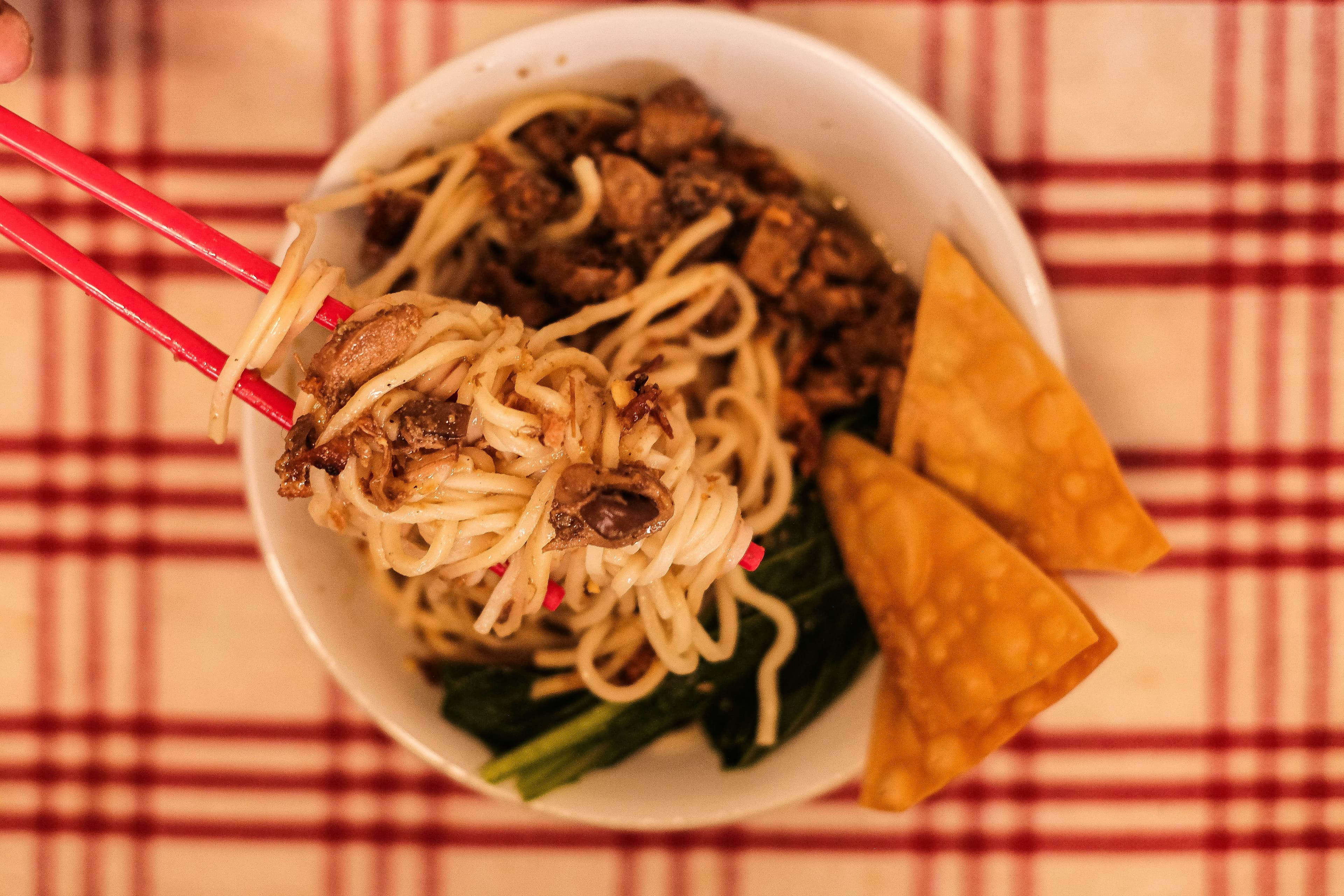
Two of Malaysia's most-ordered noodle dishes share almost the same look, a similar backstory, and one seriously confused search history. Wonton mee and kolo mee get talked about as if they're the same bowl wearing two different name tags. They are not, and mixing them up is the fastest way to get a puzzled look from whoever is behind the wok.
Two Bowls, Same Reputation, Zero Agreement
Wonton mee traces back to Cantonese immigrants from Guangzhou, where wonton noodles were built around a light broth and delicate dumplings. The name itself comes from "wan tan," loosely translated as "swallowing clouds," a nod to how the dumplings float.
When Cantonese and Hakka migrants brought the dish to Malaya in the 19th century, Kuala Lumpur hawkers made their own call: skip the broth, toss the noodles in a dark, slightly sweet sauce instead, and keep the soup on the side as an option rather than the main event.
That's why Malaysia ended up with two versions sold under one name. "Kering" (dry) gets the noodles tossed in dark sauce with char siu, wontons, and blanched greens on top. The soup version keeps things lighter, with noodles and wontons sitting in a clear pork or chicken broth. Most stalls will do either on request, and plenty of regulars order dry noodles with a small bowl of soup on the side, just to cover both moods.
The wontons themselves usually come three or four to a bowl, filled with minced pork, prawn, or a mix of both, wrapped in a thin wheat-flour skin. Some stalls boil them and drop them straight into the noodles or the soup bowl; others deep-fry them for extra crunch and serve them as a side rather than mixed in. Neither is more "correct" than the other, it's really down to what the stall built its name on.
Kolo Mee Is Not Wonton Mee's Cousin From Down South
This is where the confusion actually starts. Kolo mee did not evolve from peninsula wonton mee. It has its own separate origin story, in a different state, with a different noodle entirely.
Kolo mee comes from Kuching, Sarawak, where it developed in the 1920s from Hakka "taipoo" noodles carried over from Guangdong. Local food history credits a hawker named Kiew Shao Nyap with popularising his own version from a street stall, and the dish has been a fixture of Kuching's Chinese coffee shops ever since.
The word "kolo" means "dry mix" or "dry toss" in local Chinese dialects, which already tells you it was never built around broth. The noodles are springier and curlier than wonton mee's noodles, and they're tossed with rendered pork fat, minced pork, and fried shallots rather than being drenched in the same dark sauce used up north. A "red" version adds char siu, a "black" version leans saltier with dark soy, and a halal version swaps in chicken, duck, or seafood.
Kolo mee's cultural weight got an official bump in February 2024, when it was gazetted as a national heritage food alongside bak kut teh, burasak, and nasi ambeng. If you want the full story on how that same heritage listing turned into an actual national debate, that's already been covered here.
Why Peninsula Menus Keep Blurring The Line
Here's the part that trips people up: plenty of kopitiams in KL and Selangor now list "kolo mee" on the menu, even though what turns up is closer to standard dry wonton mee with a trendier name attached. Some of this is genuine cross-pollination as East Malaysian hawkers set up shop in the peninsula. Some of it is just menu boards borrowing a name that sounds more interesting than "dry wantan mee," same energy as a mamak calling fried rice "nasi goreng USA."
A few tells help sort out what's actually in front of you. Real kolo mee noodles are paler, curlier, and springier, closer to instant noodle texture than the flatter strands used in peninsula wonton mee. The sauce coating should look glossy and light rather than dark brown. Minced pork and fried shallots should be doing the heavy lifting on flavour, not a thick soy-based sauce. If the bowl looks like classic dry wonton mee with char siu and a dark glaze, that's wonton mee, whatever the menu says.
Kopitiam culture generally rewards knowing the difference, the same way regulars can tell a proper kopitiam apart from a mamak by more than just the drinks list. The distinctions matter more than people admit.
How To Order Wonton Mee Like You've Done This Before
Start with "kering" if you want the dry, sauced version, which is the default most stalls assume anyway. Ask for soup on the side if you want the option to switch textures halfway through the bowl, syok for humid days when a dry plate alone feels heavy.
"Tambah wonton" gets you extra dumplings, usually for a small top-up. Char siu is often sold as an add-on too, so don't assume a thin scattering is all you're entitled to; ask if a bigger portion is available. Pickled green chilies in vinegar are the standard cut-through-the-fat condiment, and most stalls will bring them without asking, but it's fair to request more.
Greens matter more than they get credit for. Kai lan or choy sum should be blanched, not boiled to mush, and a good stall keeps them separate from the sauce until the last toss so they don't wilt into nothing. If the portion feels light on protein, yong tau foo makes a natural add-on order at the same table, and there's a full breakdown on ordering that without overpaying.
Char siu quality is the real tell of a good stall, boleh or not boleh. Look for a thin, glossy glaze rather than a thick sugary crust, and a marbled cut with visible fat rather than dry, uniform slices. Stalls proud of their char siu tend to slice it at the counter in front of you rather than pre-cutting a tray hours in advance, which also means it stays warmer when it lands in your bowl.
What It Actually Costs
A standard plate of wonton mee in Klang Valley kopitiams generally lands somewhere between RM8 and RM14, depending on how generous the char siu portion is and whether the stall has built up a reputation worth charging for. Older, no-frills kopitiam stalls tend to sit at the lower end. Stalls known for thick-cut char siu or "glass" fatty slices charge closer to the top of that range, and that's a fair trade if the meat is genuinely good.
Kolo mee in Sarawak itself tends to be priced similarly to other hawker noodles in Kuching, though peninsula versions labelled as kolo mee sometimes cost slightly more simply because they're positioned as a specialty item rather than an everyday plate.
FAQ
Is wonton mee the same as wonton soup?
Not quite. Wonton soup usually refers to the broth and dumplings on their own, while wonton mee specifically includes the noodles, whether served dry with sauce or in the soup version. The dumplings are the shared element; the noodles are what make it a different order.
What's the actual difference between wonton mee and kolo mee?
Wonton mee comes from Cantonese tradition, uses flatter egg noodles, and is often tossed in a dark, slightly sweet sauce with char siu. Kolo mee is a Sarawakian dish with springier, curlier noodles, tossed in pork fat and minced pork rather than dark sauce, and it has its own separate origin in Kuching.
Why was kolo mee named a national heritage food?
In February 2024, Malaysia's heritage authorities gazetted kolo mee, known formally as mi kolok, as a national heritage food alongside bak kut teh, burasak, and nasi ambeng, recognising its long-standing role in Sarawakian food culture.
Can you get proper kolo mee outside Sarawak?
Some kopitiams in the peninsula do serve genuine kolo mee, often run by Sarawakian owners. Others use the name loosely for what's really dry wonton mee, so checking the noodle texture and sauce colour is the quickest way to tell which one you've been served.
Should you order the dry or soup version of wonton mee?
It comes down to preference. Dry gets more sauce and char siu flavour in every bite, while soup is lighter and better suited to humid afternoons. Ordering dry noodles with soup on the side is common enough that no stall will blink at the request.


