Nobody wants to be the guest in the photographs for the wrong reason. In Malaysia the risk is higher than most places, because in one wedding season you might attend a mosque-adjacent kenduri under a kanopi, a Chinese dinner in a hotel ballroom, a temple ceremony that starts before sunrise, and a garden reception where the dress code is one word on a card and no further explanation.
Different customs, different rooms, different rules. Here is what actually matters, and what people get wrong.
The Colour Rules That Carry Real Meaning
1. White Is the One Near-Universal No
Across every community here, guests avoid white, ivory, cream, and anything that photographs close to bridal. This is the single rule with no local exceptions worth arguing about.
There is a second layer at many Indian weddings, where white carries mourning associations in a number of traditions and is generally avoided by guests for that reason as well. Two separate reasons, same outcome: leave the white dress at home.
2. Black Is Read Differently Depending on the Room
At Chinese weddings, black and very dark colours are traditionally associated with funerals, and guests generally steer away from an all-black outfit. All-black is also traditionally less favoured at Indian weddings.
At Malay weddings, the colour rules are looser. There is no strong colour prohibition, and the spirit of the day is bright and celebratory — vibrant colours are genuinely welcome rather than merely tolerated.
The safe read: if you are unsure of the family's customs, a colour is a lower-risk choice than black. If you love your black outfit, break it up — a coloured blazer, a patterned shawl, gold jewellery.
Reading the Invitation
3. A Colour on the Invitation Is an Instruction, Not a Suggestion
Malaysian couples very often set a palette — dusty pink and sage, burgundy and gold, navy and champagne — and print it on the card. That palette exists because the photographer, the pelamin and the family portrait were planned around it.
Two things guests get wrong here. First, ignoring it entirely. Second, matching it too exactly and ending up looking like part of the bridal party. Aim for the family of colours, not the precise shade, and skip the palette entirely if you have been asked to.
Dressing for the Venue, Not the Photos
4. Dress for the Kanopi, Not the Ballroom
Half of Malaysian weddings happen under a canopy in an open space, at midday, in an average daytime temperature in the low thirties. The other half happen in a hotel ballroom where the air-conditioning is set to punish.
For an outdoor kenduri: natural fibres, loose cuts, sleeves that cover rather than cling. Cotton and linen-blend baju kurung, a lightweight kebaya, a cotton kurta. Heavy synthetics look excellent for eleven minutes and then look like a mistake.
For a ballroom dinner: bring something with sleeves or a shawl. Malaysians dress for the aircon rather than the weather, and a wedding dinner is the purest expression of that habit.
5. Shoes Are a Logistics Decision
At many Malay weddings, and at home receptions generally, shoes come off. At temple ceremonies, shoes come off. Which means the shoe you choose should be:
- easy to remove and put back on without sitting down
- something you would be relaxed about leaving in a pile of forty other pairs
- comfortable enough to stand in for the salam queue
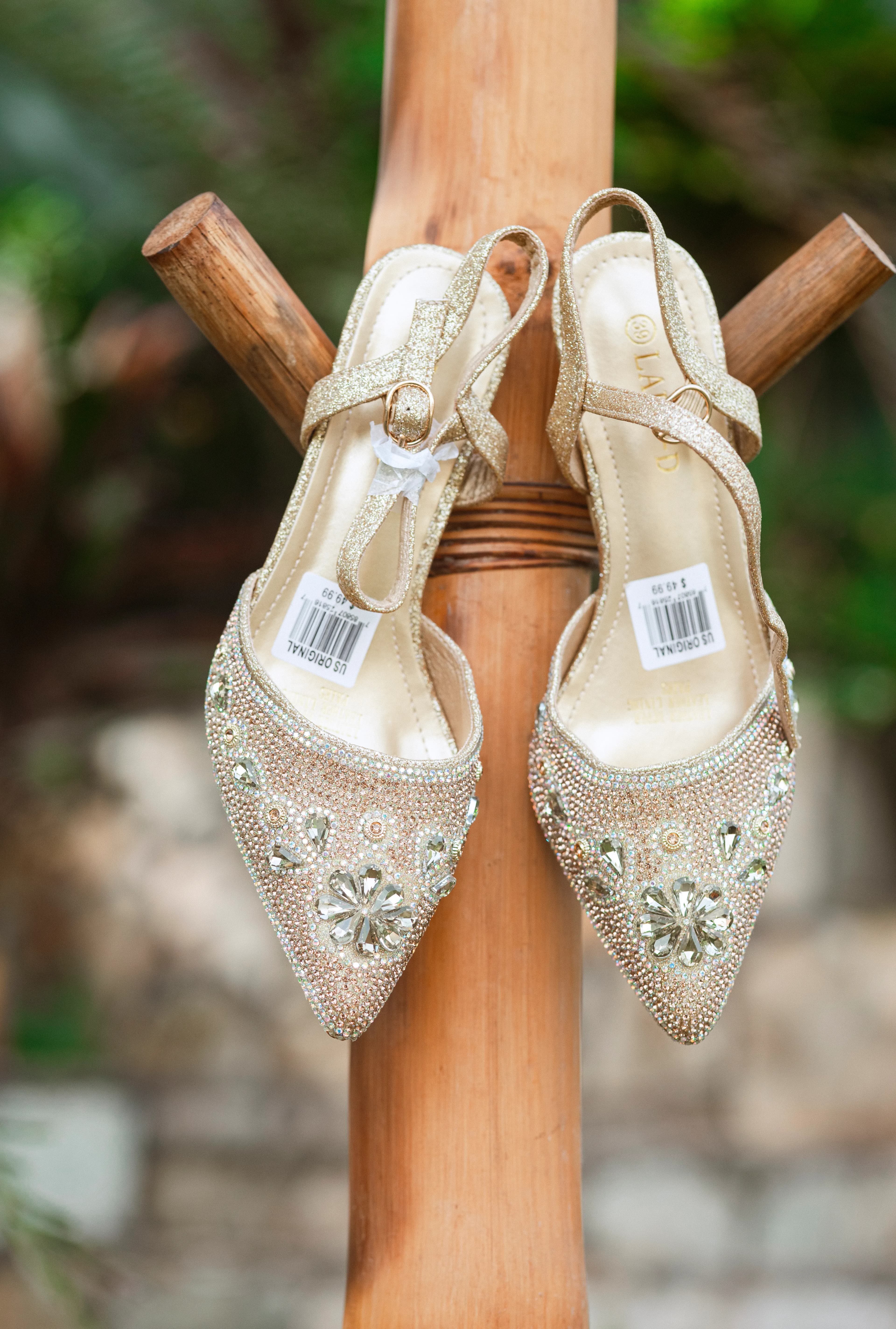
Gladiator sandals with ankle straps, knee-high boots and anything requiring a buckle are the wrong call. Slip-ons, block heels and simple flats are right. Some guests bring a small foldable pair in a bag for exactly this reason, and nobody thinks it is strange.
Coverage, Local Attire and Jewellery
6. Modesty Reads as Respect, Almost Everywhere
At Malay weddings, and at any wedding with a religious component, more coverage is the safer default: sleeves at least to the elbow, hemline below the knee, necklines that stay put when you bend to greet an elder.
At temple ceremonies, covered shoulders and covered knees are the standard expectation for all guests regardless of background.
At a hotel dinner, the room relaxes considerably — but "relaxed" here still means cocktail attire, not a beach party. The general Malaysian setting sits a notch more covered than a Western wedding of equivalent formality, and nobody has ever been criticised for being slightly more dressed.
7. Local Attire Is Always Correct, and Often Easier
If you are stuck, national dress solves the problem outright. A baju kurung or kebaya, a cheongsam, a saree or a kurta reads as respectful at almost any Malaysian wedding, including ones outside your own community — provided the styling is celebratory rather than costume-y.
For men, this is genuinely the cheat code. A well-cut batik shirt is acceptable at everything from a kampung kenduri to a five-star ballroom, and it removes the entire question of whether a jacket is required. If you have been dressing in batik for the office anyway, you already own the answer — the labels doing this well are covered in our piece on baju kurung and baju melayu as office wear.
8. Jewellery Is Where People Overshoot
Gold is celebratory at Malaysian weddings across communities and no guest has ever been faulted for wearing it. The mistake is quantity, not category. Bridal jewellery at these events tends to be substantial — a guest arriving in a full set competes with it.
One considered piece works better than four. And if you are buying something for the occasion, know what you are actually paying for: our guide to telling 916 gold from vermeil covers the difference that matters at the counter.
The Two-Question Shortcut
If you remember nothing else, ask the person who invited you two questions:
- Is it indoors or outdoors?
- Is there a colour theme?
Those two answers determine roughly ninety percent of the decision. Everything else — fabric weight, sleeve length, which shoes — follows from them. And if you want to know what actually happens once you arrive, we walked through the sequence of a Malay wedding for guests.
FAQ
Can you wear black to a Malaysian wedding?
It depends on the community. Black is traditionally avoided at Chinese weddings because of its funeral associations, and all-black is traditionally less favoured at Indian weddings. Malay weddings have no strong colour prohibition. When unsure, a colour is the lower-risk choice.
What colour should you not wear as a wedding guest in Malaysia?
White, ivory and cream are avoided everywhere because they read as bridal. White is additionally avoided by many guests at Indian weddings for its mourning associations.
Is baju kurung appropriate for a non-Malay guest?
Yes. Local attire is widely welcomed at Malaysian weddings across communities, as long as it is worn respectfully and in celebratory rather than novelty styling.
Do you have to take your shoes off at a Malaysian wedding?
Often, yes — at many Malay weddings, home receptions and temple ceremonies. Choose footwear you can slip on and off easily and are happy to leave outside.
What should men wear to a Malaysian wedding?
A batik shirt is appropriate at almost every level of formality here. Baju melayu, or a shirt with a jacket for hotel dinners, also works. Full suits are common at ballroom receptions and unnecessary at outdoor ones.
Sources: Her World on dressing for a Malay wedding, Pathfinder Relocation — Attending a Wedding in Malaysia