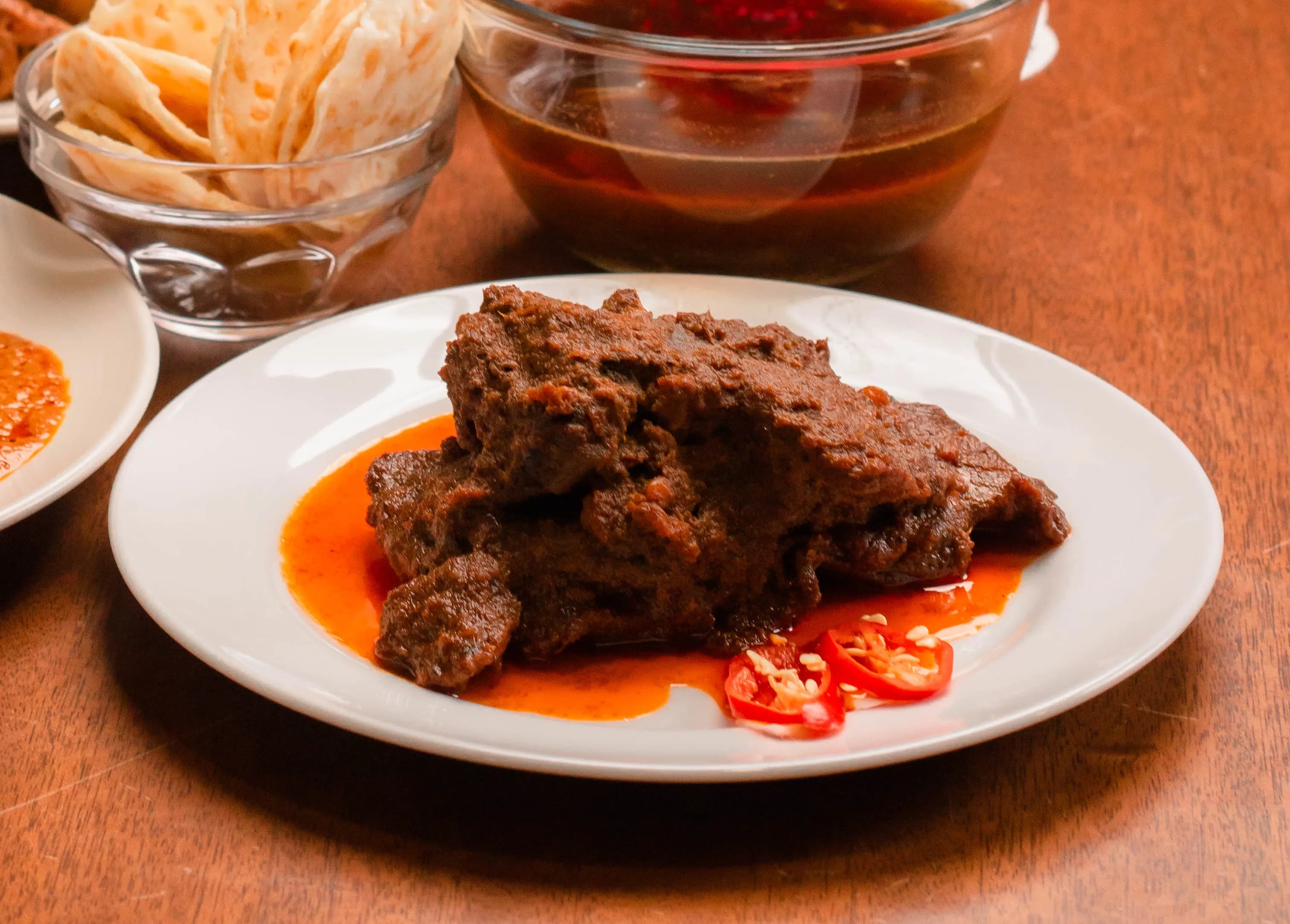
Nasi campur is the only meal in Malaysia where you commit to the price after you have already filled the plate. You point, the auntie scoops, and somewhere between the sambal and the cashier a number gets assembled that nobody showed you. Two people can walk the same counter and end up RM8 apart.
That gap is not random. It follows a pricing logic that almost no stall writes down, and once you can see it, the plate stops being a lottery.
Why nasi campur has no menu
A la carte food is priced per dish because the dish is fixed. Nasi campur is priced per plate because the plate is different every time.
The counter is a live inventory. What is in the trays at 11:30am is not what is there at 2pm, and a stall that cooked forty dishes this morning will cook a partly different forty tomorrow. Printing a menu for that is pointless.
So the pricing lives in the cashier's head, or increasingly on small labels stuck to the tray edge. Both are legitimate. Only one lets you do the maths before you commit.
Restoran 10 Mixed Rice 10 in Wangsa Maju, which runs 20 outlets, prices and labels its dishes individually so customers can work out the bill before reaching the cashier. Staff member Ah Fatt told Malay Mail the outlet serves up to 100 dishes daily and rotates the menu, and that affordability comes from turnover rather than repeated price rises.
The four things that actually set your price
Strip away the mystery and four variables do almost all the work.
How many items you take. Rice plus three is the standard unit. Every item past that has a marginal cost, and it is rarely linear — the fourth item often costs more than the second.
What category each item falls into. Vegetables sit at the bottom. Egg, tofu, tempeh and anchovies sit just above. Chicken is the midpoint. Beef, mutton, prawn and any whole fish sit at the top, sometimes at double the chicken rate.
Portion size. Curry ladled over rice is usually free or near-free. Curry with the chunks in it is not. This is where most bill shock happens, because the customer thinks they took gravy and the cashier saw meat.
Where you are standing. The same plate in an air-conditioned mall food court, an office-tower basement and an open-air kopitiam will not cost the same. Location is a multiplier applied to everything above it.
What a plate costs in KL right now
Real figures, from diners quoted by Malay Mail in June 2026.
| Diner | What they take | What they pay |
|---|---|---|
| Chen Chien, 40, works in KL city centre | One meat, two vegetables | From RM9.50; up to RM14 with an extra omelette or meat |
| Ilyana Mohd, 38, Ampang | Rice, fried egg, begedil, ayam masak lemak | Under RM10 |
| Nor Alia Samad, 37, Jalan Akar stall | Plate with fish | Around RM15 |
| Desmond Lee C.H., 35, engineer | Regular office lunch plate | RM12 to RM15; over RM15 at some outlets |
The pattern is consistent. A vegetable-led plate lands under RM10. Add one premium protein and you are at RM14 to RM15 almost anywhere. That RM5 swing is the entire game.
Both Chen and Lee remember paying RM6.50 to RM8 for the equivalent plate. Neither is comparing across decades — this is a shift most office workers have watched happen in real time, and it tracks the broader picture we covered in why eating out is inflating twice as fast as cooking at home.
Where the price jumps without warning
Four items reliably move a plate from the RM10 bracket to the RM15 bracket.
- Whole fish or fish steaks. Almost always the single most expensive thing on the counter.
- Beef and mutton. A Minang restaurant owner in Gombak, Husni, told Malay Mail that beef and seafood are the most expensive items she buys, and that she raised those specific dishes from RM7 to RM8 rather than lift the whole counter.
- Prawn in any form. Including prawn hidden inside a sambal or a vegetable dish.
- A second protein. Two meats on one plate is the most common accidental upgrade.
Seafood in particular behaves differently from everything else on the tray, for reasons we unpacked in Malaysia's market-price seafood problem.
Why costs are moving behind the counter
Operators are absorbing more volatility than the plate price suggests.
At Patin Pasu, manager Jannah told Malay Mail the restaurant has held its prices despite supply disruptions, and that the spending that once covered five days of operations now covers three. Certain ingredients in signature dishes like tempoyak patin cannot be swapped without changing the dish.
A nasi campur operator at a food court in Taman Maluri, Cheras described sourcing from five different hypermarkets and markets to find the cheapest ingredients, and switching spinach for bean sprouts when spinach gets expensive.
That is the invisible half of the transaction. The tray looks the same. The shopping behind it does not.
How to keep a nasi campur plate under RM12
None of this requires eating worse. It requires ordering deliberately.
- Look for the labels. Stalls that price per item are giving you a menu. Use it.
- Ask before you point. "Ini berapa?" on the one item you are unsure about costs nothing and removes all the guesswork.
- Take one protein, not two. This single decision is worth more than every other tip combined.
- Say gravy only, and mean it. If you want kuah without the chunks, say so while the ladle is still moving.
- Go at the right time. Between 12:00 and 13:00 the trays are full and you are choosing from everything. Late afternoon, the good stuff is gone and you are paying similar money for less choice.
- Watch the venue, not the plate. Walking one street off a mall frontage often moves the same combination down a full price band.
Is it still "economy" rice?
The Cantonese name, geng zai fan, translates as economy rice. Ah Fatt's point is that the name outlived the pricing — his outlet brands itself as a specialty mixed-rice store precisely because the old label no longer describes the business.
That is a fair reading. It is also incomplete. What nasi campur still does better than almost anything else is put six or seven separately cooked dishes in front of one person for one price. Chai boey, steamed egg, ayam masak lemak, sweet and sour pork, a vegetable, a curry — cooking that spread at home for one is absurd.
So the honest description in 2026 is not cheap food. It is variety at a price that is still hard to beat, which is a different value proposition and worth ordering with your eyes open. That habit of quietly customising the order to suit yourself is very Malaysian — the same instinct behind kurang manis.
FAQ
How much does nasi campur cost in Kuala Lumpur in 2026?
Based on diners quoted by Malay Mail in June 2026, a vegetable-led plate runs under RM10, a plate with one meat and two vegetables starts around RM9.50, and adding fish or a second protein pushes it to RM14 to RM15. Mall and city-centre outlets sit at the upper end.
Why is my nasi campur more expensive than my colleague's?
Almost always the protein. One item of beef, mutton, prawn or whole fish can add RM4 to RM6 to an otherwise identical plate. Portion size on curries with meat in them is the second most common reason.
Can I ask the price before I pay?
Yes, and you should. Asking "ini berapa?" while pointing at an item is completely normal at any stall. Some outlets label every tray, which removes the question entirely.
What is the difference between nasi campur and economy rice?
They describe the same self-service mixed-rice format. Nasi campur is the Malay term and is usually attached to Malay or Minang counters, while economy rice or geng zai fan is the Cantonese term used at Chinese mixed-rice shops. The pricing logic is identical.
Is nasi campur cheaper than cooking at home?
Not necessarily on a per-meal basis. What it buys is variety — six or seven separately cooked dishes that would be impractical to prepare at home for one person.
Sources: Malay Mail on economy rice and nasi campur operators in 2026, Malay Mail on DOSM food price data, Department of Statistics Malaysia.