Kuala Lumpur is a genuinely walkable city for about three hours a day, and almost nobody uses them. A KL heritage walk done at 7.30am is a different city entirely — the five-foot ways are empty, the light is soft, the Sultan Abdul Samad clock tower is not competing with traffic noise, and you can stand in the middle of Jalan Raja without dodging anyone.
By 11am it's a furnace and you've given up.
That timing gap is the whole trick, and it's the part travel listicles skip because they're written for people staying two nights. This is written for people who live here and have never actually walked their own city.
Below are four routes. All of them are free. None of them need a guide, a booking or a ticket. Distances are approximate and mapped by Malaysia Traveller, which publishes downloadable maps for each.
Start Early, Or Don't Bother
The single biggest reason people abandon a KL walk is heat, not distance. Three kilometres is nothing. Three kilometres at 1pm in August, with the Air Pollutant Index sitting where it has been sitting lately, is a bad afternoon.
Aim to start between 7.30am and 8am. You get roughly three usable hours before the sun turns hostile.
Two other things worth knowing before you go. First, check the API for your area on the Department of Environment's APIMS portal — Malaysia has been hazy through August, and a long outdoor walk is the first thing to drop when readings climb. Second, most of these routes pass places of worship. Cover your shoulders and knees, take your shoes off where you're asked to, and don't photograph people mid-prayer.
Bring water. There is very little shade on the colonial route. And have a landing spot in mind for afterwards — a KL park, most of which open early and cost nothing, with the opening hours and entry fees here, or a public library, which is free, air-conditioned and the most underrated place in the city to sit down after a walk.
Route 1: The Colonial Core Around Dataran Merdeka
Roughly 3km, about 2.5 hours. Nearest rail: Masjid Jamek (LRT).
This is the postcard loop, and it's the one to do in the week before 31 August if you want the Merdeka connection to land.
The circuit runs around Dataran Merdeka and takes in the Sultan Abdul Samad Building, St Mary's Cathedral, the Royal Selangor Club, the Kuala Lumpur City Gallery, the National Textile Museum and the KL Memorial Library. It's dense — you're never more than a few minutes from the next building.
The walking itself costs nothing. Going inside the museums doesn't, always. If you plan to duck in somewhere air-conditioned halfway, it's worth knowing what KL museums actually charge with a MyKad before you commit.
One caution for late August: Dataran Merdeka is the focal point of national day activity, and access, parking and road layouts around it can change during the run-up. If you're walking this route in the last week of the month, check DBKL's channels the night before rather than turning up hopeful.
Route 2: Chinatown and the Temple Cluster
Roughly 2.5km, about 2 hours. Nearest rail: Pasar Seni (LRT/MRT).
Start at Central Market, walk through to Petaling Street, and let the route pull you past the cluster of temples that sit within a few hundred metres of each other — Sri Mahamariamman, Guan Di, and Sin Sze Si Ya among them. It is one of the few places in the country where you can walk between a Hindu temple and two Chinese temples in under ten minutes.
The shophouses are the actual attraction. Look above the awnings. The ground floors have been renovated into cafés and phone accessory shops, but the upper storeys — the plasterwork, the vents, the original window proportions — mostly haven't.
Morning is also when Petaling Street is at its least performative. The souvenir stalls aren't up yet, the wholesalers are unloading, and the kopitiam trade is real rather than for photos.
Route 3: Brickfields and Little India
Roughly 2km, about 1.5 hours. Nearest rail: KL Sentral (all lines).
The shortest route and the easiest to fit into a morning. Brickfields packs a Hindu temple, a Buddhist temple, several churches and a Sikh gurdwara into a walkable grid — the Sri Kandaswamy Temple and the Buddhist Maha Vihara are the usual anchors.
What makes Brickfields worth walking rather than driving through is the density of ordinary life happening alongside the landmarks. Flower garland sellers, sari shops, banana leaf restaurants opening up, temple bells at odd hours. It's a working neighbourhood that happens to be a heritage district, not the other way round.
Because it starts at KL Sentral, this is the route to pick if you're coming in from outside the city and don't want to think about parking at all.
Route 4: Kampung Baru to Chow Kit
Roughly 3km, about 2 hours. Nearest rail: Kampung Baru (LRT).
Kampung Baru is a Malay settlement that has sat in the middle of the city since the 1890s, and walking it is the closest thing KL has to time travel — traditional timber houses on stilts with the KLCC towers directly behind them.
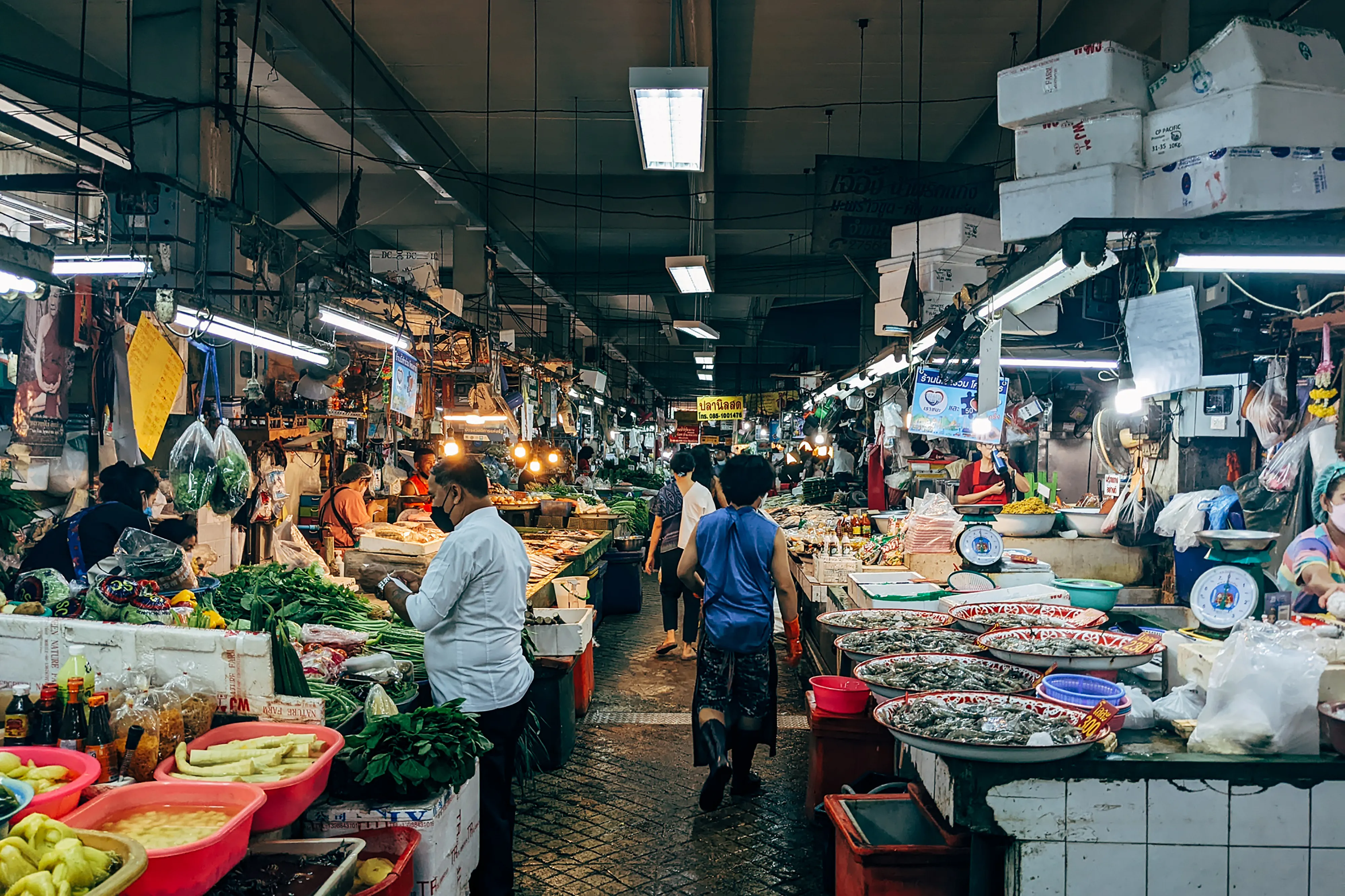
The route continues north into Chow Kit and its wet market. If you've only ever done a night market, a morning wet market is a different animal: it's louder, faster, and the trade is between people who do this every day. Our no-car guide to pasar malam in KL and PJ covers the evening version if you want to compare.
Walk this one respectfully. It's a residential neighbourhood where people are getting their kids to school, not an exhibit.
The Free Guided Tour, With a Caveat
If you'd rather have someone explain the buildings, DBKL has long run a free guided heritage tour of the Dataran Merdeka area, starting from the Kuala Lumpur City Gallery at No. 27, Jalan Raja. It has typically run on Monday, Wednesday and Saturday mornings, covers around a dozen heritage buildings, and caps group size — so turning up early matters.
The caveat is real: visitor reviews over the past few years report the schedule shifting without much notice. Treat the days and times as indicative, not guaranteed. Email [email protected] or check visitkl.gov.my before you build a morning around it. Tourism Malaysia also publishes a free KL heritage walk booklet if you'd rather read ahead and go alone.
You will not do all four routes in one weekend. Pick one. Do it properly. The city is more interesting at 3km/h than it has any right to be.
FAQ
Do I need a permit for any of these KL heritage walks?
No. All four routes are on public streets and require no permit, ticket or booking. Entry to individual museums or buildings along the way may be charged separately.
What is the best time of day for a heritage walk in KL?
Between roughly 7.30am and 10.30am. After that, heat and glare make longer routes genuinely unpleasant, and the shade on the colonial route is minimal.
Can I do these routes without a car?
Yes — every route here starts within walking distance of an LRT, MRT or KTM station. Masjid Jamek for the colonial loop, Pasar Seni for Chinatown, KL Sentral for Brickfields, and Kampung Baru for the fourth.
Is it safe to walk in KL during haze?
Air quality varies by district and by hour. The Department of Environment classes an API reading above 100 as unhealthy, and advises sensitive groups — including children, older adults and people with asthma — to reduce time outdoors at that level. Check APIMS on the morning itself.
Which route is best for a first-timer?
Brickfields. It's the shortest, it starts at KL Sentral, and it packs the most variety into the least walking.