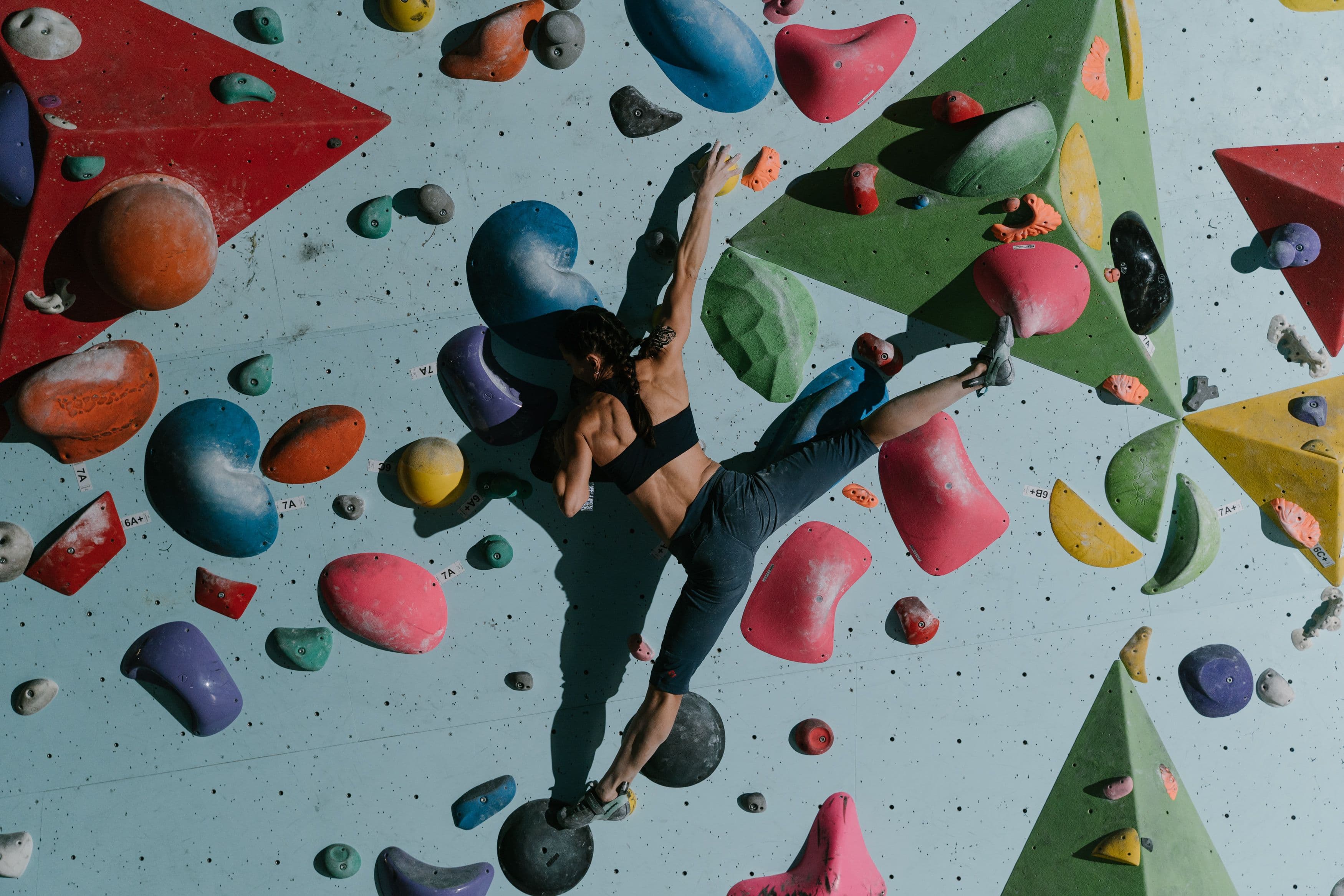
Somewhere between the overcrowded commercial gym and the yoga studio that makes you feel like you're intruding, a small, colourful revolution has been climbing up the walls of Klang Valley. Bouldering gyms — indoor climbing spaces where the walls stay under four metres, nobody wears a harness, and a rope is nowhere in sight — have gone from a niche pursuit for outdoor climbers killing time between monsoon seasons to one of the more talked-about social workouts in KL and PJ. No membership intimidation, no mirrors angled at your worst insecurities, no unspoken dress code. Just chalk-dusted hands, coloured plastic holds, and strangers cheering each other up a wall they've never touched before.
Why Bouldering Feels Like The Anti-Gym
Traditional gyms sell solitude with extra steps. You clock in, plug in headphones, avoid eye contact, and clock out having spoken to no one. Bouldering gyms do the opposite by design. Routes — called "problems" — are meant to be puzzled out in groups. Someone always has an opinion on how you should have shifted your hip on that last move, and it's rarely unwelcome.
That social-first structure is exactly what makes bouldering read less like exercise and more like a hangout that happens to torch your forearms. There's no solo treadmill shuffle involved. You're waiting your turn, watching someone else attempt the same problem, picking up beta (climbing slang for the sequence of moves that gets you up a route) by osmosis. It's closer in spirit to a board game night than a spin class, which is probably why it's landing with the same crowd that's been filling board game cafes in KL and PJ looking for a place to just be around people.
The No-Experience Barrier Is The Whole Point
Ask anyone who's tried it: the appeal isn't the athleticism, it's the accessibility. You don't need to know how to climb before you climb. Staff walk first-timers through the basics — how to fall, how to read a route, how not to grip a plastic jug like you're trying to strangle it — in about fifteen minutes, and most gyms rent out shoes and chalk on the spot. There's no six-week onboarding, no assessment of your VO2 max, no awkward first day where you don't know how any of the machines work.
It also scales oddly well across skill and body type. A wiry teenager and a stiff-shouldered desk worker can be on adjacent routes graded for their level, both getting an honest workout, both mildly humbled by a hold that looked easier from the ground. That flatness — nobody's obviously "better" in a way that makes the room feel hierarchical — is a big part of why it functions as a third place rather than just another fitness class bolted onto a mall.
Where To Actually Go In Klang Valley
The names below are current as of this writing, checked against each gym's own site rather than old listicles, because gyms open and close and prices drift.
Camp5 is the closest thing Malaysia has to an institution here, running since 2005 and a member of the Climbing Wall Association since 2008. It now has outlets across the valley, including Camp5 Jumpa at Sungei Wang Plaza in Bukit Bintang (bouldering, top-rope and lead climbing plus an attached Beastpark ninja course), Camp5 1Utama in Petaling Jaya, Camp5 Eco City, Camp5 KL East, and a boulder-only outlet at Utropolis in Shah Alam. A registered climber's day pass at Camp5 Jumpa runs roughly RM31.50 off-peak (weekdays before 4pm) to RM42 peak, with a 10-visit shareable pass at RM360.
B-Hub Bouldering in Petaling Jaya leans harder into the third-place framing, pairing its climbing floor with a proper café and coworking-style booths for calls. A day pass is RM24 for youths, RM30 off-peak on weekdays, and RM40 peak or on weekends, and a Trial Pack (two entries with shoe rental included) is RM62.
MadMonkeyz Climbing Gym in Wangsa Maju is the scrappier, more affordable option — a day pass is RM25, with a first-timer combo of one pass plus an intro class at RM38. It also runs monthly outdoor climbing trips for anyone who catches the bug and wants to graduate to real rock.
Cheaper Than It Looks, If You Don't Overcommit
Compare a single bouldering day pass to a mid-range commercial gym's monthly fee and bouldering looks expensive per visit. Compare it to what people already spend on a night out, a facial, or a round of golf, and it starts looking like a reasonable way to spend a Tuesday evening. Most of these gyms also sell multi-visit passes that bring the per-session cost down close to what a decent hawker meal costs, which matters when the whole appeal is showing up casually rather than locking into a 12-month contract you'll resent by March.
It also doesn't require owning anything. No activewear upgrade, no shoe purchase, no gym bag ritual — just rental shoes and a chalk bag, both usually under RM15 combined. On a rainy Klang Valley weekend, it sits comfortably next to the usual rotation of indoor activities Malaysians default to when the sky won't cooperate.
FAQ
Do I need climbing experience to try bouldering?
No. Every gym listed here is built around first-timers, with staff briefings covering safety and basic technique before you're allowed on the wall, and shoe and chalk rentals available on arrival.
How much does a bouldering day pass cost in KL or PJ?
Based on gyms' own published rates, expect a day pass somewhere between roughly RM25 and RM42 depending on the venue and whether you're visiting during peak or off-peak hours.
Is bouldering actually a good workout?
Yes — it's a full-body pull-heavy workout that hits grip strength, back, shoulders and core, alongside the problem-solving element of figuring out a route, which is part of why it doesn't feel like conventional exercise.
What should I wear to a bouldering gym?
Comfortable, stretchy clothing that allows a full range of motion. Most gyms require climbing shoes, which can be rented, and socks are recommended for hygiene with rental shoes.
Is bouldering dangerous without ropes?
Bouldering walls are kept low, typically under four metres, and landing areas are padded with thick crash mats, so falls are expected and built into how the sport is taught, unlike roped climbing where the risks are different.


